What a Core Loop Actually Is and Why Your Obby Probably Lacks One
Four design elements separate obbies that hook players from ones that feel like a chore.

The phrase "game loop" means two completely different things depending on who's saying it, and that mix-up sends a lot of obby creators chasing the wrong fix. Programmers use "game loop" to describe the per-frame cycle running under the hood: input, update, render, repeat, thousands of times a minute, keeping the game from freezing up or falling apart. Designers use the exact same phrase to describe something else: the repeating pattern of player actions and rewards that makes a game worth playing. These two things share a name but live in completely different layers. The design loop runs inside the programming loop, sure, but the two get solved with completely different tools: one is a code problem, the other is a design problem. So when an obby creator hears "fix your loop" and starts digging into frame rates or Lua update cycles, they're solving a problem they don't actually have. This article covers the design-layer loop, which decides whether a player comes back tomorrow or never opens the game again.
The four-part anatomy every real core loop shares
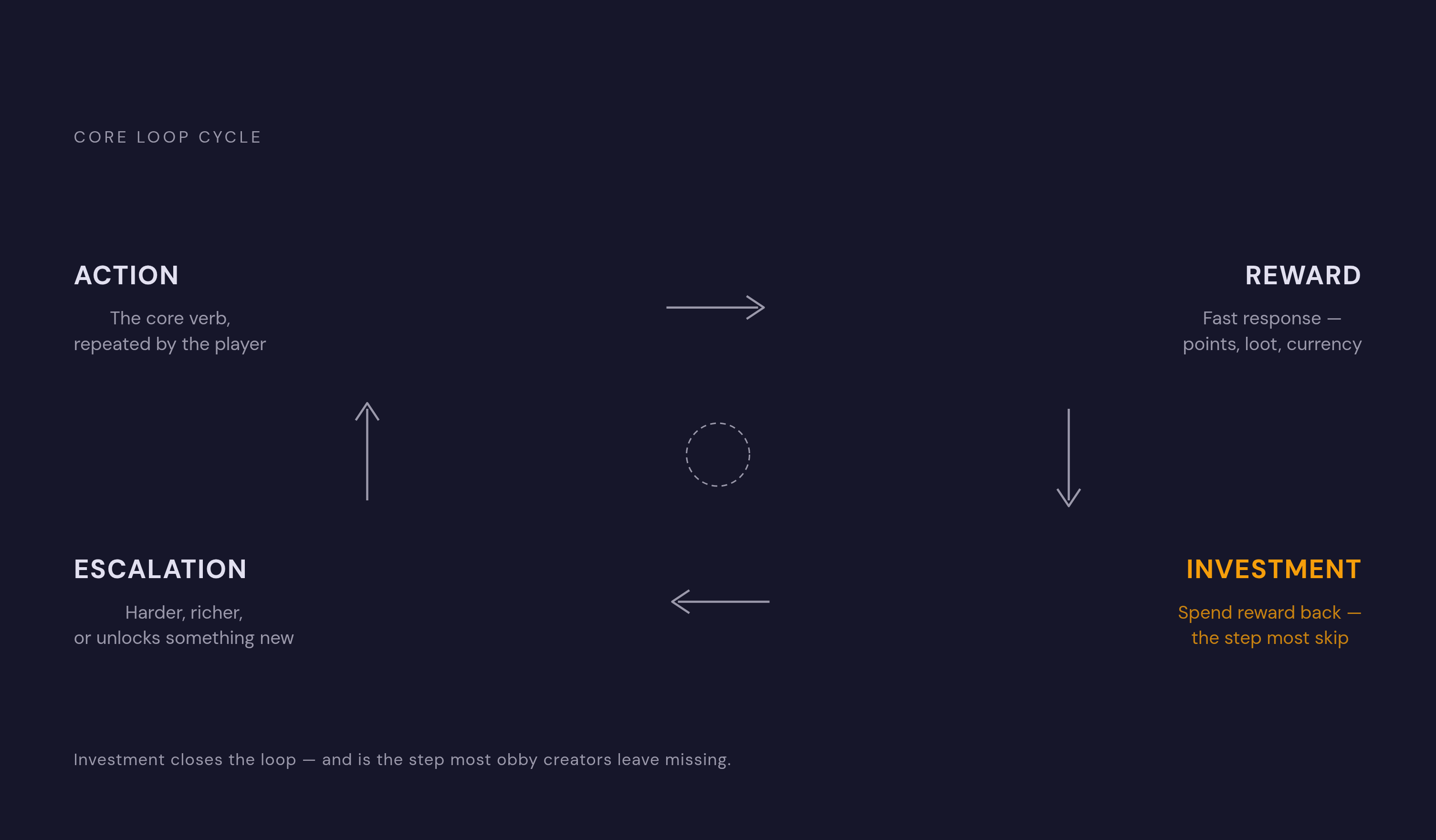
A core loop is a specific, four-part cycle, and each part has a job to do. The first part is action: the core verb the player actually performs, over and over. If that verb isn't satisfying on its own, no amount of loop design around it will save the game. The second part is reward: the system's response to that action, whether it's points, loot, a cleared room, or currency, and it has to land fast enough that the player feels the connection between what they did and what they got. The third part is investment, and it's the one most beginners skip entirely: the player takes that reward and spends it back into the game somehow. That's the step that closes the loop, turning it into something players cycle back through. The fourth part is escalation: the next pass through gets harder, richer, or opens up something new. If a loop skips escalation, even with the other three parts nailed down, it starts to feel stale fast.
There's a clean way to test whether a loop actually has all four parts, and it comes down to three questions. What is the player doing? What's stopping them? Why are they doing it? A loop that can't answer all three clearly is missing something, and usually that something is investment or escalation.
Loops also nest inside each other, operating at different timescales. A micro loop plays out in seconds, the moment-to-moment feel of jumping, swinging, or shooting. A meso loop plays out over minutes, like clearing a stage, grabbing a reward, and making a choice about what to do with it. A macro loop plays out across entire sessions, pulling the player back days later to chase something bigger. Slay the Spire is a clean example of how this nesting works in practice: the macro loop runs on beating an act boss, which unlocks new cards and relics for future runs, giving every single run (even the losing ones) a reason to feed back into the next one. Another action roguelite runs a tighter version of the same idea: survive the wave, grab the experience orbs, level up mid-run, and watch your build escalate in real time as the screen fills up with chaos. Game designer Daniel Cook draws a useful line here between loops and arcs. Loops are repeatable systems that build what he calls "wisdom" through repeated feedback cycles. Arcs are broken loops, exited immediately, delivering their value exactly once. Games built on loops scale with the player. Games built on arcs burn through their content budget and then just stop.
What an obby gives a player
Running the obby genre through that four-part anatomy makes the gap obvious fast. A standard obby gives players the action (jumping) and usually some version of a reward (reaching a checkpoint, finishing a stage), but the investment and escalation steps are missing or badly broken. Mechanics are what players do. A core loop is why players keep doing it, through progression, through rewards, through challenge that actually means something. That distinction matters because an obby creator who spends all their time polishing obstacle placement and timing windows is optimizing the one part of the loop that was never the problem.
The only required action in most obbies is beating the course, full stop. There's nothing to invest, no resource earned along the way that gets spent back into the game, and no system that opens new options once the course is done. The player finishes, or the player quits, and either way, that's the end of the relationship. Designers have a term for the feeling this produces: "loop fatigue," the absence of any felt reason to keep going once the obstacles are cleared.
The obby genre also tends to fail a second, bigger test: the meta-loop test. The core loop is the moment-to-moment gameplay, the jumping and dodging. The meta loop is what ties long-term goals back to that core loop, through unlocks, story beats, or cosmetic rewards, giving players an actual reason to open the game again tomorrow. Most obbies have no meta layer. Adding more stages or a harder difficulty chart just extends the arc, and arcs get consumed once and never revisited.
What games with working loops do differently
The games that keep players coming back are built differently, structurally, so that every step of the loop feeds directly into the next one. Grow a Garden is a good example of this in action: it took the idle-grow loop that mobile games have run on for years (a genre whose entire design is built around the investment step) and stacked social trading on top of it, adding a meso loop that stretches session length well past the basic act of watching plants grow. Tycoon games bake investment directly into their bones, where the output of one cycle, income or resources, becomes the input for the next one, upgrades or expansion. That's also why tycoons that add real management decisions and multiplayer interaction, instead of just passive dropper mechanics, are picking up steam: they deepen the investment step without touching the core verb.
The thread running through all of it is the same formula, every time: core actions, plus meaningful rewards, plus a way to spend those rewards back into the game, plus a harder or richer next pass through the cycle. Every piece is present. Every piece is connected to the next one. Nothing in that chain is optional.
Retrofitting a core loop onto an obby
None of this means tearing an obby down and starting over. Retrofitting a core loop onto an existing obby means adding the two structural pieces the genre typically skips, investment and escalation, on top of the action and reward that are usually already there.
Start by naming the verb more precisely than "jump." Something closer to "progress through a gauntlet to prove skill" gets a lot closer to a real core-loop verb, and that reframing matters because a sharper verb points directly at what the reward and investment steps should look like. From there, add a reward that lands immediately: a checkpoint badge, a collectible token, a small currency drop, something the player actually receives the moment a stage clears, so the cause and effect registers right away. Then close the loop with investment. The reward has to be spendable back into the game somehow, whether that's cosmetics that show up on the player's character mid-run, a rebirth mechanic that resets the course in exchange for a permanent speed boost, or a shortcut unlock. Any system that takes the reward from step two and turns it into something the player carries into the next pass through the loop does the job.
Escalation comes last: harder jumps that open up a new option or reveal a new layer of the game that wasn't there before. Tying difficulty tiers to the investment step, spending earned tokens to unlock entry into a harder zone, for example, makes escalation feel earned.
Run the same three diagnostic questions on the retrofit to check the work: What is the player doing at each stage? What's stopping them? Why are they doing it? If the answer to that third question is still just "to finish the course," the investment step isn't actually there yet. Watch for the cosmetic-only trap: bolting on a currency shop or a daily login bonus without a real investment mechanism underneath doesn't close anything. Players notice fast when a reward has no real connection to what they do next, and the loop stays broken no matter how many shiny items sit in the shop.
Why AI game creation tools can't scaffold the loop
AI tools can throw together an obstacle course in seconds flat. What they can't do is make the loop decision for a creator, because that decision is a design choice, not a generation task. That means the gap this article has been describing doesn't close as creation gets easier. It gets more important to understand, because the tooling is removing every excuse except the design one.
The mechanic-versus-loop distinction plays out very specifically here. AI can place obstacles, no problem. It can't decide what a player should invest between stages, how escalation should connect back to the reward, or what the meta loop promises across sessions, because those are structural calls that need a human decision before any tool has something to build from. Browser-based AI creation platforms have made the obstacle-building part nearly frictionless. studs.gg, for instance, lets creators go from a plain-text description straight to a published game, no installation and no coding background required. But the prompt still does all the work. "Make an obby" produces exactly that: an obstacle course and nothing more. "Make an obby where players earn coins at each checkpoint and spend them to unlock a faster rebirth" starts specifying an actual loop, before a single obstacle gets generated.
None of this is a knock on the tools themselves. It's a design truth that was true long before AI-assisted creation existed. Understanding core loop anatomy just means a creator can hand any tool, AI or otherwise, a sharper and more specific brief, and get something back that's built to be returned to rather than completed once and abandoned.
The missing step obby creators overlook
Once a creator actually understands core loop anatomy, it doesn't just patch up one existing obby. It changes the questions that get asked before anything gets built. The question shifts from "how do I make the obstacles better?" to "what does the player invest between obstacles, and what does that investment unlock?" That's a structural shift in how the game gets planned, not a small tweak to level five.
The three diagnostic questions, what is the player doing, what's stopping them, why are they doing it, stop being something checked after launch when retention numbers look bad. They become part of planning the game before a single obstacle gets placed. A creator who's internalized the four-part anatomy also stops being boxed in by genre labels: a strong investment step is the real structural difference between an obby and a tycoon, between a course that gets played once and a game players actually return to. The genre tag on the game matters a lot less than whether those four parts, action, reward, investment, escalation, are all present and wired together.
Building the obstacles has never been easier or faster than it is right now. What's left is a design decision, one that finally has a name and a precise four-part shape to follow, ready for the next creator sitting down to describe the game they actually want to build.