How Adopt Me Kept Players Coming Back Every Day
The game engineered a cost to missing a single day that compounds across years.
Adopt Me has surpassed tens of billions of all-time visits as of mid-2026, built and run by a team of roughly 40 people. That ratio is the whole story: a studio small enough to fit in a single conference room produced one of the most-visited experiences ever made, and genre charm alone does not explain a gap that size. The real explanation is structural. Adopt Me engineered a daily cost of absence, one that compounds the longer a player stays away, and that engineering is what this piece sets out to trace.
Why Adopt Me became a game players feel they cannot afford to skip
Plenty of games let you raise a virtual pet. Few of them turn a missed Tuesday into a measurable financial setback. Adopt Me did, and the mechanism is not one clever feature doing all the work but three systems, layered on top of each other, each one reinforcing the other two. Pet aging taxes your time. Rarity tiers multiply that tax. Limited-time events make certain windows of time non-refundable. Those three systems combine into a game that survives without needing to be the most creative thing on the platform. It just needs to be the hardest one to walk away from.
Pet aging as a structural obligation for daily login
Pets in Adopt Me move through a fixed sequence of life stages: newborn, junior, pre-teen, teen, post-teen, full-grown. That sequence sounds like flavor text, the kind of cosmetic detail a studio adds so pets feel alive. It is not cosmetic. A full-grown legendary pet trades for meaningfully more than the same pet as a newborn. Aging a pet is a financial act, not a decorative one. And because reaching full-grown status takes repeated play across multiple days, no single marathon session gets you there faster. The design does not pay you for patience. It charges you for absence. Some will point out that plenty of games use progression timers that reset or cap out, so what makes this one different? Pet aging never resets, accumulating into a permanently higher-value asset, so falling behind a friend who plays daily is not a temporary gap you close next weekend. It accumulates.
Neon and Mega-Neon pets as a compounding economy
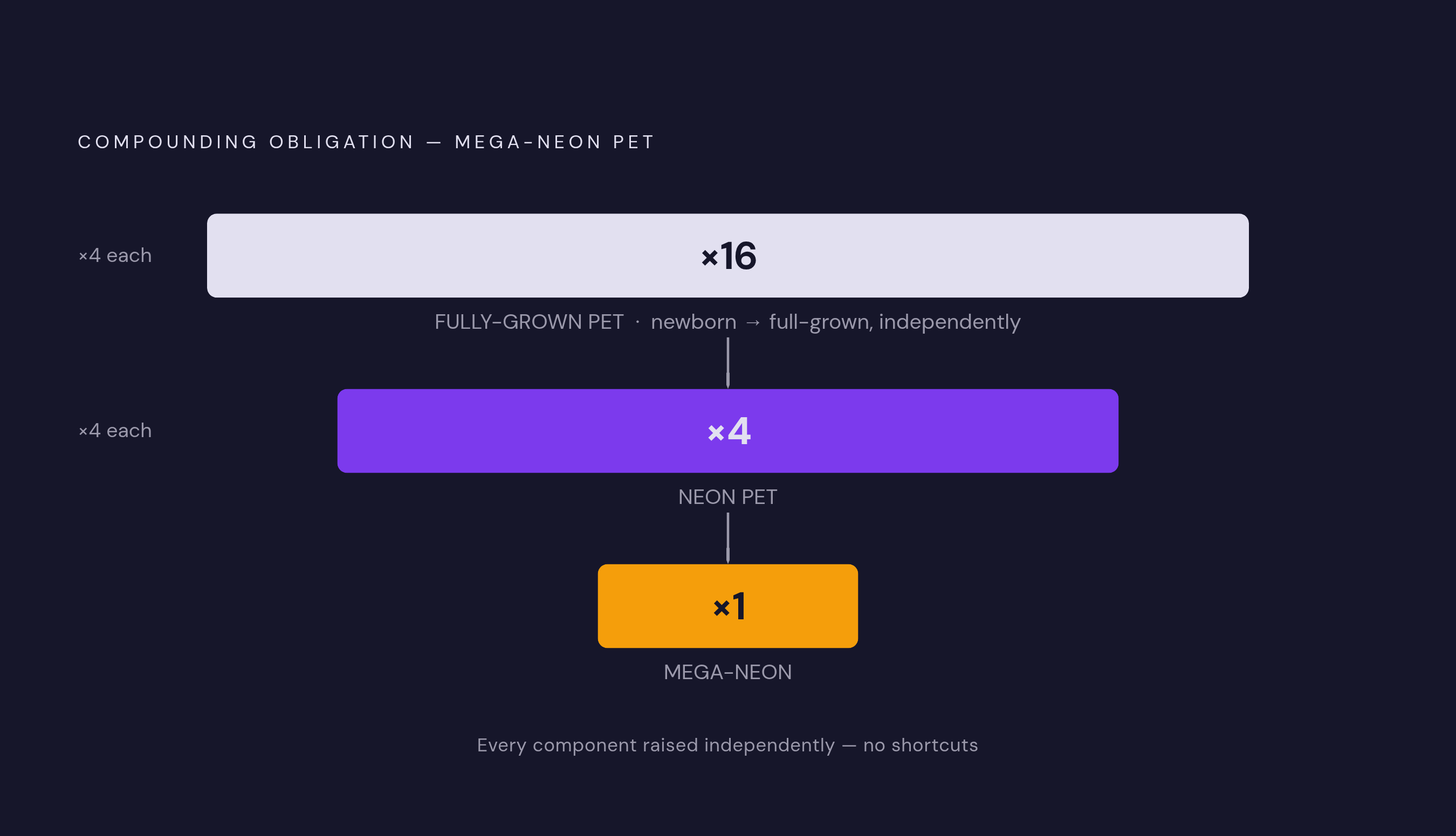
Aging one pet is the entry fee. The Neon system is where the real obligation kicks in. Combining four fully grown pets of the same type produces a Neon. Combining four Neons produces a Mega-Neon. Each step up requires every component pet to have gone through the full aging process on its own. A single Mega-Neon sitting in someone's inventory represents the accumulated play time of many separate pets, each one independently raised to full-grown. That is not a grind extension. That is a multiplication of the original obligation, binding players across dozens of sessions.
The trading hierarchy that results is steeply stratified. Players who have climbed to Mega-Neon hold assets that cannot be reproduced on any short timeline, and that scarcity gives them real leverage in the economy, the kind that does not erode just because a new update ships. Here is the part that makes the system self-sustaining rather than self-limiting: it motivates both ends of the ladder at once. Veterans sitting on high-tier Neons have a reason to keep logging in, because stepping away risks newer players catching up or trading dynamics shifting without them. Newcomers staring up at that hierarchy have a reason to keep logging in too, because the only way to close the gap is to put in the hours. Two completely different motivations, same daily login.
The scarcity calendar and the irreversibility of limited-time events
Aging and Neons reward showing up consistently. Events work the opposite direction: they punish showing up late by closing the door permanently. Limited-time event pets exist only while an event runs. Once it ends, those pets become unobtainable through normal play, full stop on new supply, while demand keeps climbing as fresh players discover the game and want what they missed. That is a fixed-supply asset class manufactured on a schedule, and players have learned to read the pattern correctly: skipping an event does not just mean missing a fun few weeks. It means permanently paying a markup, through trading, for something that used to be free for the price of showing up.
The accessory shop showed what happens when that scarcity mechanism runs without clear rules. For a stretch, items vanished from the shop for long, undefined periods with no signal on whether they'd return, which pushed traders to overpay out of fear the item might be gone for good. The January 2026 overhaul introduced rotating stock, giving items a predictable return schedule after that stretch of indefinite disappearance. That solved one problem and opened another: an accessory that comes back through rotation is not truly limited anymore, and that has split opinion. Veterans who remember the old scarcity read rotation as a devaluation. Newcomers who just want a fair shot at owning things read it as relief. Either way, the shop's history is proof that this economy is live. It reacts to pressure, and it occasionally breaks under it.
The Trading Hub update's access requirements
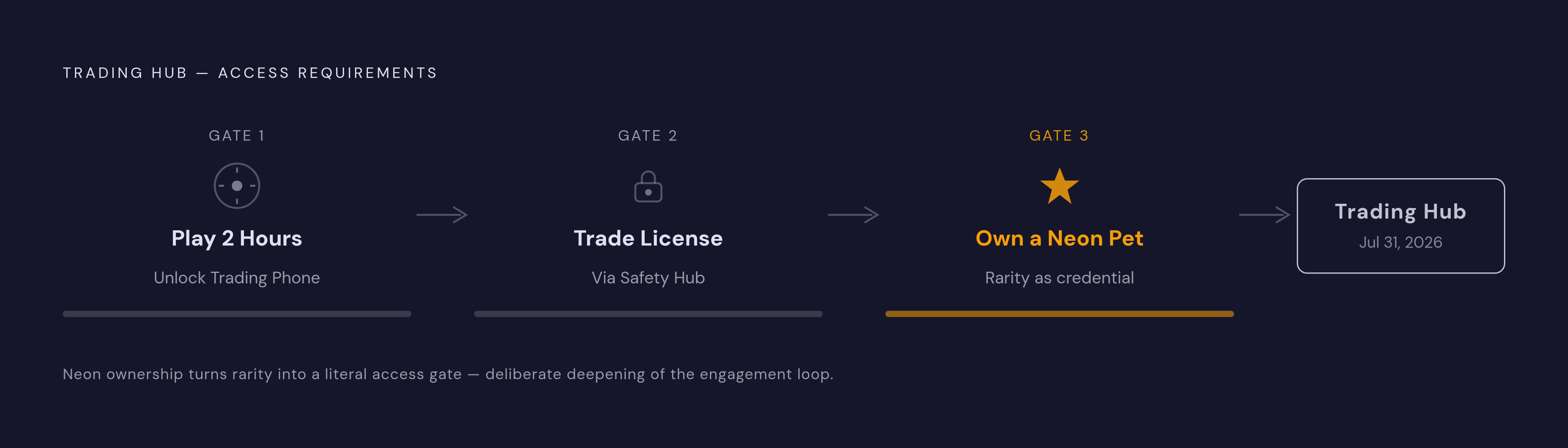
The Trading Hub launched on July 31, 2026, and it shows that Adopt Me's developers understand the engine they're running and intend to deepen it. Getting into the Trading Hub is not a matter of tapping a menu. A player has to play for two hours to unlock a Trading Phone, obtain a Trade License through the Safety Hub, and own at least one Neon pet.
Lining those three requirements up against the three mechanisms already covered shows they match. The two-hour session targets raw time-in-game. The Trade License adds a progression gate on top of that. The Neon pet requirement turns the rarity ladder into a literal access credential, a key you can only cut by playing. Put together, the update means access to the game's most important social and economic space is itself a play-session generator. Anyone who wants to trade has to first do the work that gives trading its meaning. Note the requirements as they stand; whether players find them reasonable isn't the point here, how they function is.
What the aging-rarity-events loop cannot do on its own
The loop works beautifully for players already inside it. That same compounding structure becomes a wall for anyone who shows up late, and that wall is both the system's strength and its exposed weak point. A Shadow Dragon exists only for players who were logged in during the 2019 Halloween event. The gap between someone who was there in 2019 and someone who joined last month is a gap of history, not effort, and history does not refund itself.
For long-term players, that stratification is what makes the trading economy feel worth investing in. For newcomers, a newborn pet getting outclassed immediately by assets that took years to build can read less like a game and more like an inheritance system. That tension is the strongest argument against treating Adopt Me as a simple template to copy. AI-assisted tools can speed up building a game environment with aging mechanics, rarity tiers, and scheduled events built in from day one. None of that generates a decade of compounding scarcity, none of it manufactures community norms overnight, and none of it produces an asset class whose entire value comes from historical exclusivity. The real fault line is between AI as an accelerator for building the systems and AI as a substitute for the history that makes those systems matter. A freshly generated game can have all three mechanisms running on day one. It starts at zero, without the accumulated social proof that makes Adopt Me's economy feel consequential to the people trading inside it.
Lessons for creators building new games from Adopt Me's architecture
None of the three mechanisms covered here is a trade secret. Time-based progression, compounding rarity tiers, and a scarcity calendar are design choices built with intention, available to anyone willing to engineer engagement deliberately. A new game built with these systems in place from launch day starts accumulating the same kind of compounding returns Adopt Me spent years building toward, starting the clock sooner.
What has changed is how much it costs to try. AI-assisted creation tools now let a creator prototype a game world through text prompts, without first mastering scripting or 3D modeling. The retention architecture (aging, rarity, scarcity) can get layered on top of an environment that used to take a technical team months to build. studs.gg, for one, runs entirely in the browser, with nothing to install, which strips out the setup friction that used to separate "I have an idea" from "I'm actually building something." That gap is where most retention-aware design plans used to die quietly, stuck at the installation screen.
None of this promises a new game will reach Adopt Me's scale. Billions of visits and a decade of compounding scarcity are not things a prototype launches with. The transferable piece is the philosophy underneath the numbers: make every day in the game feel consequential, and make missing a day feel like it costs something. That philosophy is teachable, it's buildable with tools available right now, and because the entire mechanism runs on compounding, a creator who starts today is already better positioned than one who waits for the idea to feel more finished.